I recently had the opportunity to appear on CTV News for a Sunday night segment with Matt Grillo. One of the main questions was:
If sales are going down, why are prices still rising?
And the short answer is:
A decline in the number of sales does not automatically mean a decline in prices.
What we’re currently seeing is that, as sales activity slows down, inventory begins to accumulate. But the key is not simply looking at sales or inventory on their own. You need to compare the number of sales to the total number of properties available in order to determine whether we’re in a seller’s market, a balanced market, or a buyer’s market.
For example, in the Greater Montreal Area, sales declined from 3,709 in July 2025 to 3,338 in July 2026. When you compare that level of sales to approximately 19,790 active listings, it represents roughly 5.9 months of inventory, which still falls within seller’s-market territory.
As a general rule:
- 0 – 8 months of inventory: Seller’s market, upward pressure on prices
- 8 – 10 months: Balanced market, prices tend to remain relatively stable
- 10+ months: Buyer’s market, downward pressure on prices
So even though the number of transactions has declined, supply is still not high enough relative to demand to create significant downward pressure on prices.
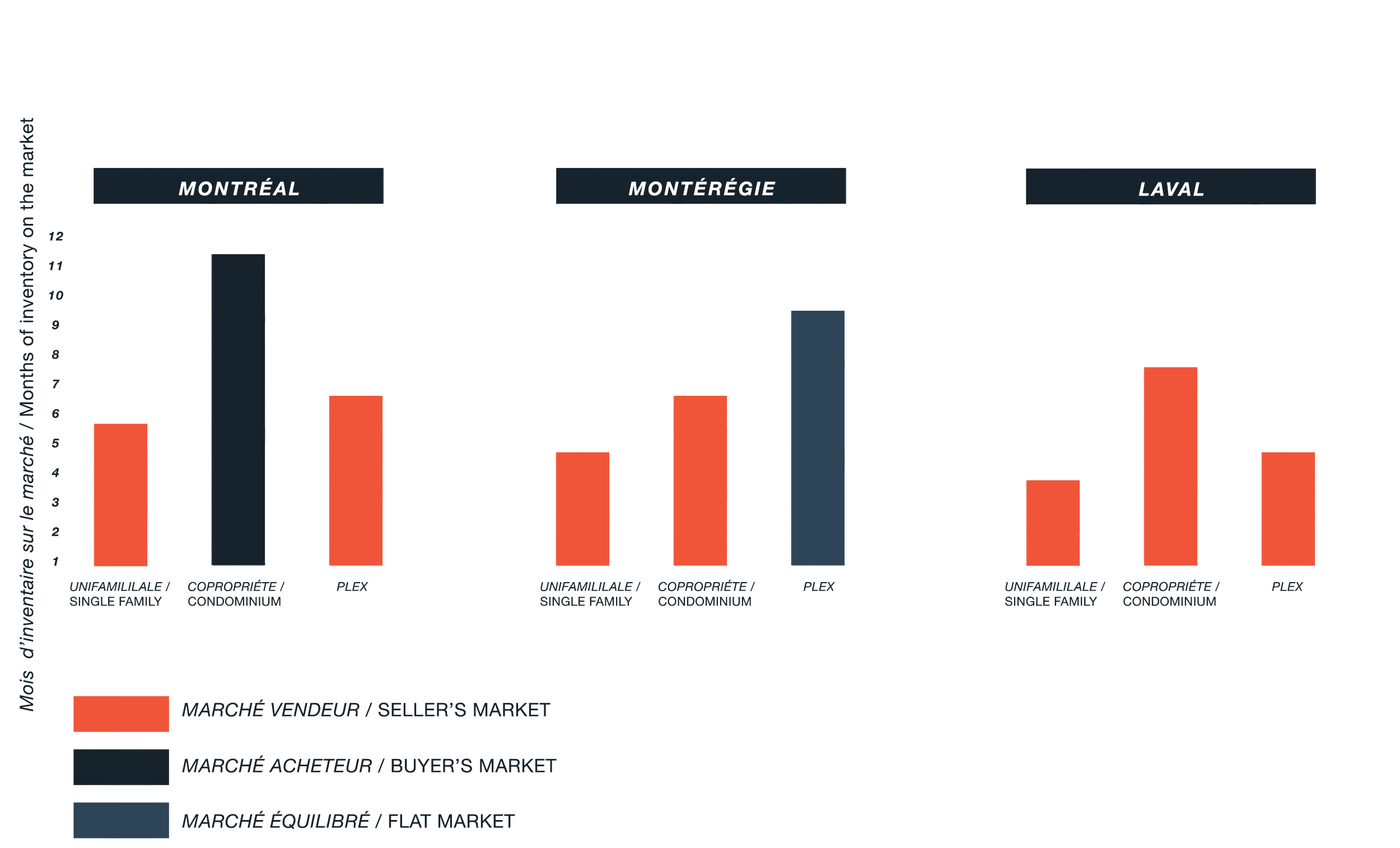
That said, these figures represent the Greater Montreal Area as a whole, and some market segments are performing much better than others.
Here’s a breakdown of where things currently stand by property type by region: